If you have noticed changes in your hearing or want to understand how your hearing is evaluated, you may be surprised by the different hearing test types available. A professional hearing assessment is not always just about listening to tones through headphones. Audiologists may use several tests to understand how well you hear, how your ears respond to sound, and whether additional evaluation may be appropriate.
At a hearing clinic, the tests selected for an adult or child depend on factors such as age, symptoms, medical history, communication needs, and the reason for the assessment. If you are looking for a hearing test Newmarket families can access locally, understanding the different tests can help you know what to expect.
This guide explains common types of hearing tests used for adults and children, what each test measures, and why an audiologist may recommend one test or a combination of tests.
Why Do People Need a Hearing Assessment?
Hearing changes can happen gradually, which means some people may not immediately realize that their hearing has changed. Adults may begin asking others to repeat themselves, increasing the television volume, or finding conversations difficult in restaurants and other noisy environments.
For children, hearing is closely connected with communication, language development, learning, and participation at school. Parents may seek a hearing assessment Newmarket families can access when they have concerns about a child’s response to sound, speech development, listening behaviour, or communication.
A professional audiology assessment can help determine whether hearing is within expected limits, identify hearing loss when present, and provide information that can guide appropriate follow-up or referral.
7 Common Hearing Test Types
1. Pure-Tone Audiometry
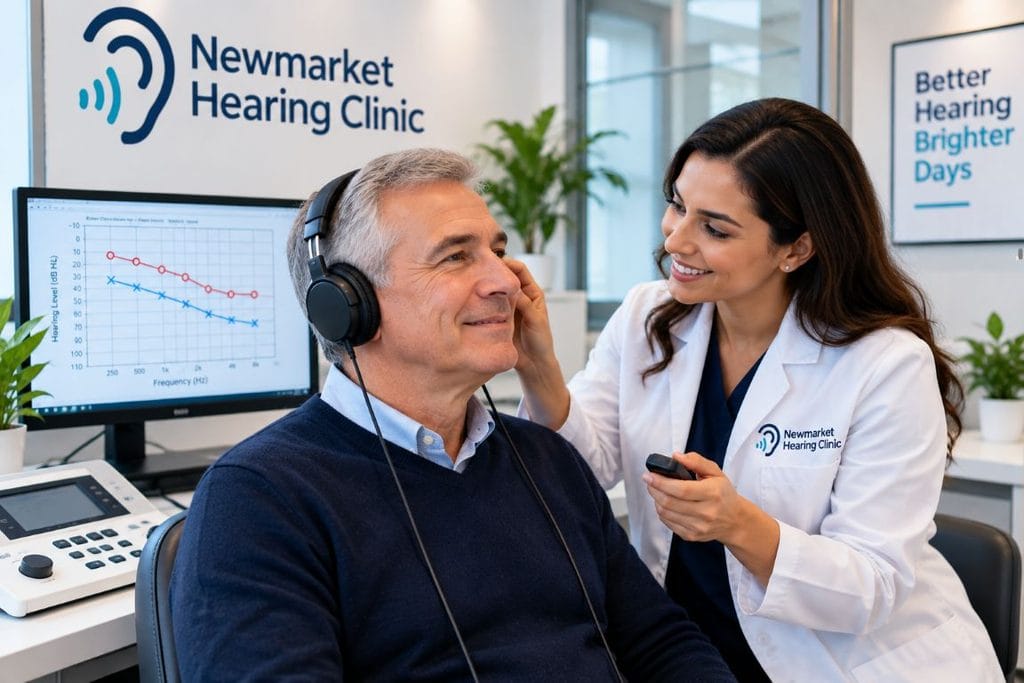
Pure-tone audiometry is one of the most familiar hearing test types. During the test, you listen for tones presented at different frequencies and volumes through headphones or insert earphones. You respond whenever you hear a sound, allowing the audiologist to measure the softest sounds you can hear at different frequencies.
The results are recorded on an audiogram. Testing may include air-conduction and, when appropriate, bone-conduction measurements. These results help the audiologist understand hearing sensitivity and whether the pattern may be consistent with a particular type of hearing loss.
2. Speech Audiometry
Speech audiometry evaluates how well you detect and understand spoken words. Depending on the assessment, you may be asked to repeat words or respond to speech presented at different levels.
Speech testing provides information that complements pure-tone testing. It can also help an audiologist understand how hearing changes may affect everyday communication.
3. Speech-in-Noise Testing
Some people can hear individual sounds reasonably well but struggle to understand conversations when background noise is present. Speech-in-noise testing can help explore this type of listening difficulty.
During the assessment, you may be asked to identify or repeat speech while competing background noise is presented. The results can provide additional information about communication difficulties that may not be fully reflected by a quiet-room hearing test alone.
4. Tympanometry
Tympanometry evaluates middle-ear function rather than simply measuring how softly you can hear a tone. A small probe is gently placed in the ear canal while air pressure changes are introduced.
The test measures how the eardrum and middle-ear system respond. Tympanometry may provide useful information when an audiologist is assessing concerns involving middle-ear fluid, pressure, or other middle-ear conditions.
5. Otoacoustic Emissions (OAE) Testing
Otoacoustic emissions, commonly called OAE testing, measure sounds produced by the inner ear in response to stimulation. A small probe is placed in the ear canal and presents sounds while the equipment records the ear’s response.
OAE testing is commonly used in hearing screening and can be particularly useful when evaluating infants and young children who may not be able to complete conventional behavioural testing reliably.
6. Auditory Brainstem Response (ABR)
An Auditory Brainstem Response test, or ABR, measures electrical activity generated by the auditory system in response to sound. Small sensors are placed on the skin while sounds are presented through appropriate earphones or other transducers.
ABR may be useful when reliable behavioural responses cannot be obtained or when additional information about the auditory pathway is needed. It can be particularly relevant in some pediatric assessments and other situations where conventional behavioural testing is difficult.
7. Pediatric Behavioural Hearing Tests
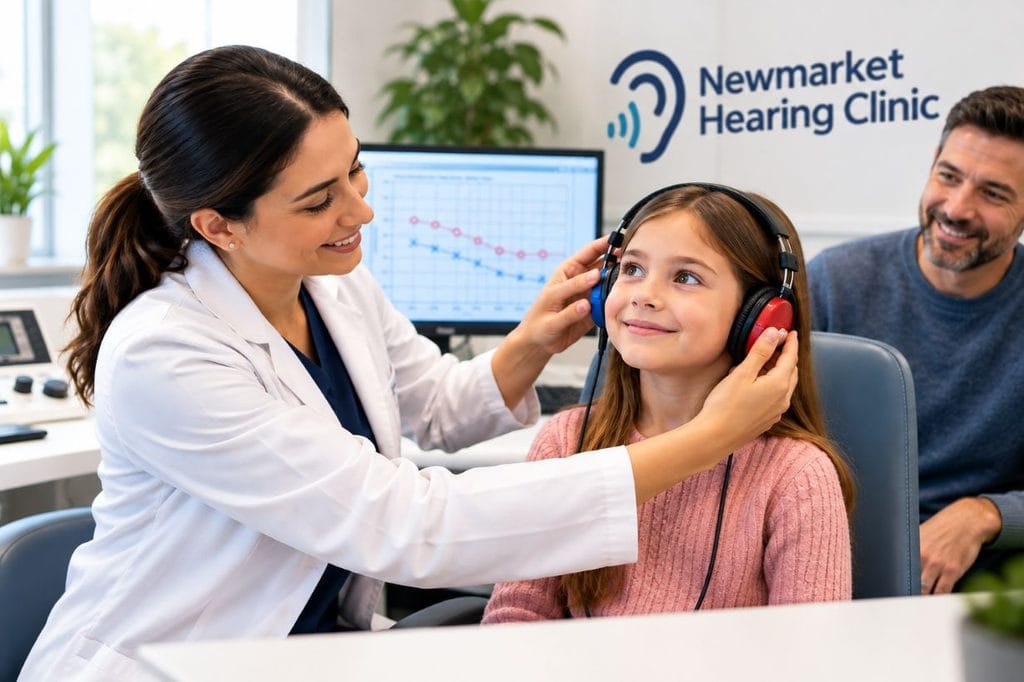
A hearing test for children is adapted to the child’s age, developmental level, communication abilities, and attention span. Children do not always respond to hearing tests in the same way as adults, so audiologists can use age-appropriate techniques to obtain reliable results.
Depending on the child’s age and abilities, testing may include behavioural observation, visual reinforcement audiometry, conditioned play audiometry, pure-tone testing, or speech testing.
Hearing Tests for Adults
An adult hearing test may include a combination of case history, ear examination, pure-tone audiometry, speech testing, and middle-ear testing. The exact combination depends on the person’s symptoms, history, and the questions the audiologist needs to answer.
Adults may seek testing because of difficulty following conversations, frequently asking people to repeat themselves, tinnitus, exposure to loud noise, concerns about age-related hearing changes, or difficulty hearing in restaurants and group conversations.
A comprehensive assessment can establish useful information about current hearing and help determine whether monitoring, hearing technology, further assessment, or medical referral should be considered.
Hearing Tests for Adults and Children
Hearing tests for adults and children are not necessarily identical. Audiologists select and adapt testing based on age, development, communication abilities, symptoms, and the reason for the assessment.
Adults can generally participate in conventional behavioural hearing tests, while younger children may need play-based or visual reinforcement techniques. Additional tests such as tympanometry, OAE, or ABR may be considered when appropriate.
The goal is not simply to perform as many tests as possible. The goal is to obtain useful and reliable information about the person’s hearing and determine whether additional evaluation or support is needed.
Pediatric Hearing Assessment: What Parents Should Know
A pediatric hearing assessment is designed around the child’s age, developmental stage, communication abilities, and individual needs. Parents may be referred for testing when there are concerns about a child’s response to sound, speech and language development, listening behaviour, or school-related communication.
For younger children, audiologists may use play-based techniques or visual reinforcement to obtain reliable responses. Other tests, including tympanometry, OAE, or ABR, may also be considered when appropriate.
Early identification of a hearing concern can provide families with useful information and help determine whether monitoring, intervention, or further assessment is appropriate.
What Happens During a Hearing Assessment?
A hearing assessment usually begins with questions about your hearing history, symptoms, medical background, noise exposure, and communication concerns. The audiologist may also examine the ears before selecting the appropriate tests.
The assessment may include one or more hearing test types depending on the patient’s age and needs. The audiologist then reviews the findings and explains what they mean. If additional assessment or medical follow-up is appropriate, the audiologist can discuss the next steps.
What Does an Audiogram Tell You?
An audiogram is a visual representation of hearing thresholds measured at different frequencies. It can show whether hearing sensitivity falls within expected ranges and whether there is a difference between the right and left ears.
An audiogram is one part of a complete hearing assessment. An audiologist considers the audiogram alongside speech testing, middle-ear findings, case history, symptoms, and other relevant results when discussing the overall picture.
When Should You Book a Hearing Test?
You may want to arrange a hearing assessment if you notice difficulty following conversations, frequently ask people to repeat themselves, have trouble hearing in background noise, experience tinnitus, or feel that your hearing has changed.
For children, parents may want to discuss testing with an audiologist when there are concerns about responses to sound, speech and language development, listening, communication, or school-related difficulties.
Frequently Asked Questions About Hearing Tests
What is the most common hearing test?
Pure-tone audiometry is one of the most commonly used hearing test types. It measures hearing sensitivity at different frequencies and produces an audiogram. A complete hearing assessment may include additional tests depending on the patient’s age, symptoms, and hearing history.
Are there different hearing test types for adults and children?
Yes. The hearing test types selected for adults and children can differ based on age, developmental level, communication abilities, and the reason for testing. A pediatric assessment may use play-based techniques, while adults can generally participate in conventional behavioural testing.
What happens during a hearing assessment in Newmarket?
A hearing assessment Newmarket patients receive may begin with a discussion of hearing concerns and medical history, followed by an ear examination and appropriate hearing tests. The audiologist explains the results and discusses next steps based on the findings.
Does a hearing test hurt?
Most routine hearing tests are non-invasive and should not be painful. Some tests involve wearing headphones, while others use a small probe placed in the ear canal. The audiologist can explain each procedure before testing begins.
How long does an audiology assessment take?
The length of an audiology assessment varies depending on the patient’s age, hearing concerns, medical history, and the tests required. A comprehensive evaluation may take longer than a basic hearing screening.
Can a hearing test detect hearing loss in one ear?
Yes. Hearing can be measured separately in each ear. The results can show whether hearing differs between the right and left ears and help the audiologist determine whether additional assessment is appropriate.
Book a Hearing Assessment in Newmarket
If you are concerned about your hearing or your child’s hearing, a professional assessment can provide useful information about how the ears and auditory system are functioning. The appropriate hearing test types depend on the individual, so an audiologist can recommend an assessment based on age, symptoms, history, and communication needs.
At Newmarket Hearing Clinic, hearing assessments are available for adults and children in Newmarket and surrounding communities. If you are looking for a hearing test Newmarket patients can book locally, contact the clinic to discuss an appropriate assessment.
Ready to take the next step? Contact Newmarket Hearing Clinic to ask about booking a hearing assessment.